

From Old to Gold: Why retrofitting your HVAC system is a smart investment
- Theme
- System personalisation
- Reading time
- 12 minutes
- Published
- By
- Silas Bäuerle
As buildings face rising energy costs, stricter sustainability targets and increasing pressure to perform optimally, the humble role of the HVAC system has never been more important. Yet so many buildings and facilities still rely on dated equipment, sometimes decades old. An HVAC retrofit offers a practical, cost-effective way to unlock modern efficiency, without the disruption of a full HVAC replacement.
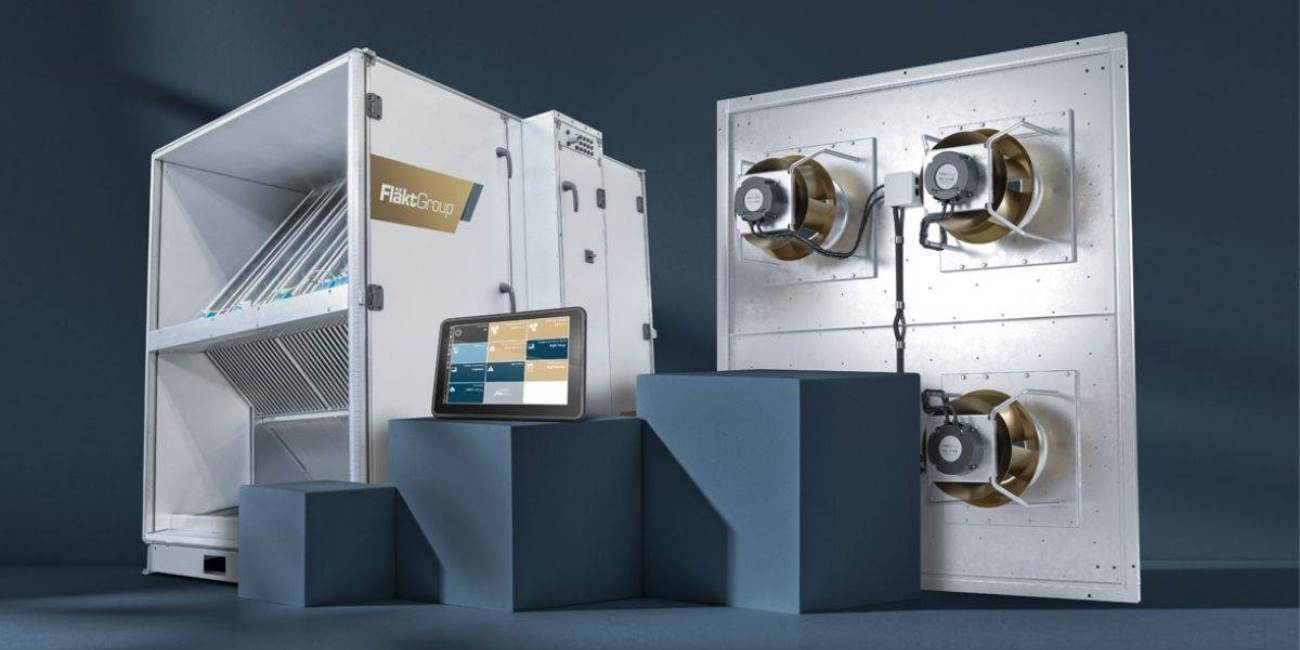
Upgrading your HVAC system delivers cost, performance and sustainability benefits
Are you facing HVAC criticism? Tired of those HVAC insults that your system is not cool enough? If you keep hearing comments like “the system’s not keeping up”, then you’re not alone - ageing HVAC equipment can attract its fair share of complaints. But here’s the good news: there’s a simple solution. It’s called HVAC retrofit.
If you’re working with a retro system, you don’t always need to consider a full HVAC replacement. A smart AHU refurb or trargeted retrofit can transform outdated equipment into a far more efficient, reliable, and modern setup, without the cost and disruption of a full replacement.
Pretty cool, right?
Key insights at a glance
Retrofitting provides a practical way to modernise ageing HVAC systems — improving performance, reducing energy use, and avoiding the cost and disruption of full replacement.
- Outdated systems struggle to meet modern demands as buildings evolve, usage changes, and expectations for efficiency and compliance increase
- Performance declines over time, leading to uneven comfort, higher energy bills, and systems that work harder for the same output
- Targeted upgrades restore efficiency and reliability by improving key components such as fans, heat recovery, pumps, and controls
- All‑in‑one retrofit solutions maximise results by combining multiple upgrades into a single, integrated package for an integrated HVAC retrofit
- Retrofitting delivers strong financial and sustainability benefits through significant energy savings, reduced CO₂ emissions, and improved long-term system performance
So let me ask you this.
- Do some areas feel too hot, while others never seem warm enough?
- Has your building evolved, but your HVAC system is stuck in the past?
- Are your energy bills creeping up without a clear explanation?
- Are you pushing ageing equipment to meet modern demands?
If the answer is yes, don’t wait for total system failure and don’t assume a full HVAC replacement is your only option.
Because the real issue often isn’t that your system has stopped working. It’s that it’s no longer working the way your building needs it to. That's where HVAC retrofit solutions come in.
Buildings evolve. Usage changes. Standards move on.
What was once a high-performing system can quickly become outdated, struggling to keep up with new occupancy levels, modern control requirements, and today’s expectations around energy efficiency and compliance.
At the same time, even well-designed HVAC systems lose performance over time.
Wear, fouling, and ageing components quietly reduce efficiency - driving up energy consumption and operating costs without an obvious failure point.
That’s where retrofitting comes in.
By upgrading key components, improving controls, and restoring performance, all while keeping the existing unit in place, retrofit solutions address both challenges head-on. You regain efficiency, improve system output, and extend equipment life, without the cost, disruption, or downtime of a full replacement.
Let’s explore why HVAC retrofitting is fast becoming the preferred path for facility managers, engineers, and building owners.
Retrofitting delivers immediate and significant energy savings
Across Europe, HVAC systems account for almost half of a buildings operating energy. Older units – many 20, 30, even 40 years old – were not designed to meet today’s expectations for efficiency. An HVAC retrofit can include:
- Replacing belt-driven fans with EC technology
- Upgrading outdated heat recovery systems
- Adding modern, intelligent controls
- Improving pump efficiency.
Can reduce electrical consumption by up to 50% and cut heating energy by a further 25-30%.
In total, retrofitted systems consistently achieve up to 80% combined savings depending on the starting condition. These savings aren’t theoretical either, they are backed by the real-world projects, data and decades of operational experience at our disposal. This level of improvement makes retrofit a compelling alternative to full HVAC replacement.
Understanding Lifetime Costs and Efficiency Loss in AHU Systems
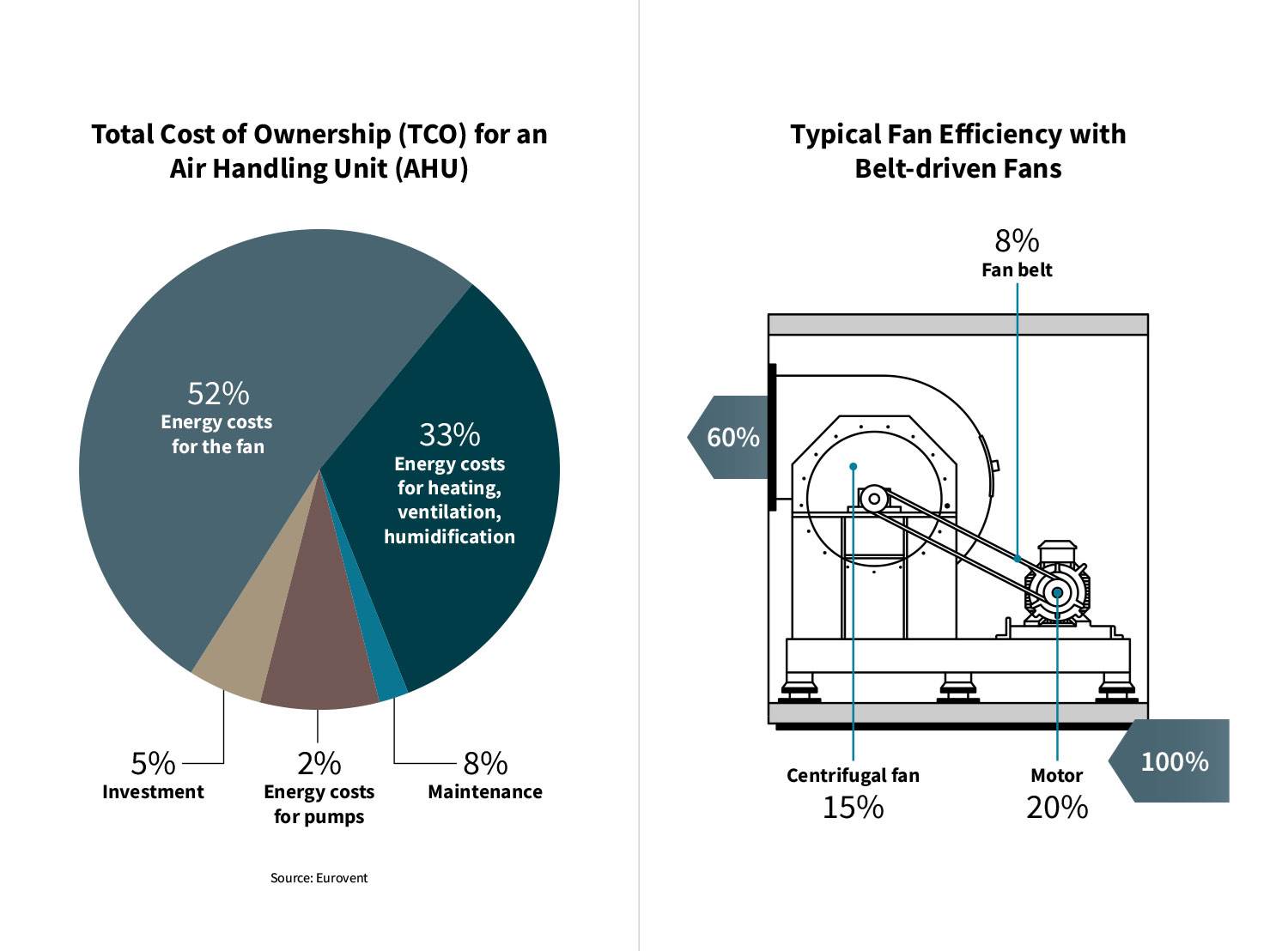
In this example you can see on the left side we highlight the Total Cost of Ownership (TCO) for an Air Handling Unit (AHU).
While the initial investment represents only a small portion of the overall cost, energy consumption and ongoing maintenance make up the majority of lifetime expenses. This is why retrofitting existing units can deliver significant long‑term savings.
On the right side we illustrate the efficiency loss associated with belt‑driven fans. Due to mechanical components and transmission losses, up to 40% of the fan’s efficiency can be lost, making modern direct‑drive solutions far more attractive.
ROI from Retrofit Solutions: Proven Results Across Pharma and School Buildings
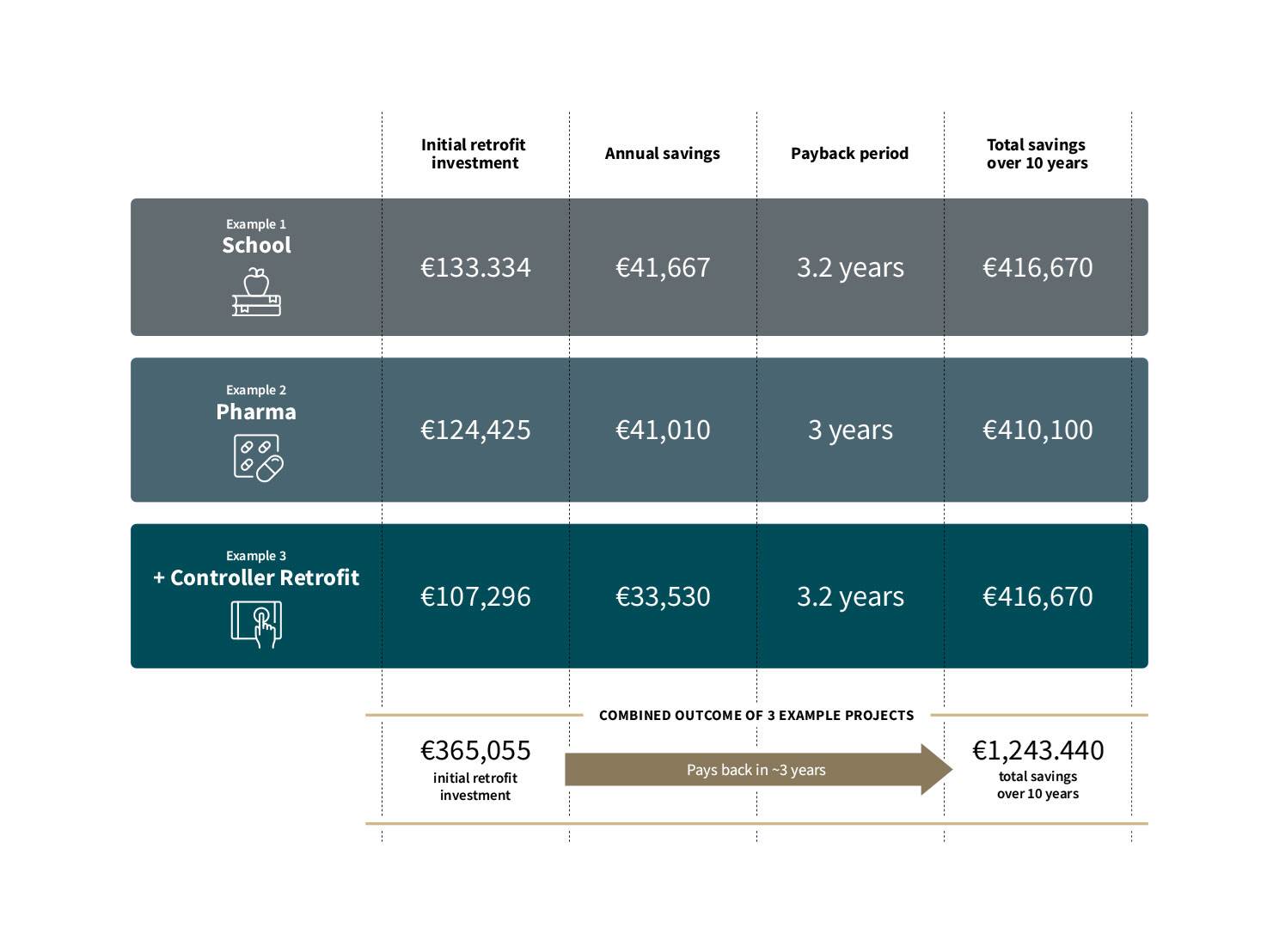
This infographic presents the return on investment (ROI) achieved in three different case studies using retrofit solutions.
Each example demonstrates how upgrading existing systems with our solution delivers measurable financial gains, improved performance, and long‑term value.
Importantly, the ROI shown reflects the specific investment volume of each individual project, providing a realistic and transparent view of the efficiency and payback achieved.
Together, these case studies highlight the consistent and proven impact of our retrofit packages across a range of real‑world applications.

Retrofitting reduces CO2 emissions and supports sustainability goals
Buildings contribute 31% of global CO2 emissions and HVAC systems are a major driver of this footprint, so something needs to happen here. As many countries tighten regulations under recognised building standards such as EPBD, older systems become a risk. But it doesn’t need to be this way. A well-executed HVAC retrfoit helps to:
- Align with national climate targets
- Reduce CO2 output without major structural changes
- Prepare buildings for future smart-grid or digital energy management requirements
- Improve indoor air quality while reducing environmental impact.
And for companies reporting on ESG requirements, retrofitting directly supports measurable sustainability KPIs such as:
- Carbon footprint (Total CO2 emissions)
- Total energy consumption (kWh)
- Energy intensity/ carbon intensity.
- Renewable energy usage (%)
- Waste generation and recycling rate
- Water usage efficiency
- Indoor environmental quality (IEQ)
- Refrigerant leak reduction.
Improved reliability and reduced risk of downtime
Ageing happens to us all and just like the human body, the components of an HVAC unit begin to feel a little bit less stable over time. Much like targeted medical intervention, retrofitting addresses the most vulnerable components without replacing the entire system. For an HVAC system that means navigating difficult-to-source parts, unexpected failures and increasing service calls. Retrofitting replaces the most failure-prone elements while keeping the existing housing and duct connection intact. Instead of committing to a full HVAC replacement, a targeted AHU refurb for example focuses on the most fialue prone elements, resulting in:
- Greater system stability
- Predictable maintenance
- Longer equipment life
- Fewer unplanned outages.
In critical environments – schools, hospitals, data centres, clean rooms – reliability is essential in maintaining minimal downtime.
Retrofitting avoids challenges of a full replacement
| Full HVAC Replacement Challenges | HVAC Retrofit Benefits |
| Lack of space for larger, modern units | Fits into existing unit footprint |
| Structural restrictions | Avoids major structural work |
| Permit requirements | Typically fewer approvals required |
| Building downtime or forced closures | Can be performed during operation (in most cases) |
| Higher installation costs | Significantly more cost-effective |
| Disruption to occupants | Minimal disruption to occupants |

School HVAC Retrofit case study
Schools are a prime example of where effective ventilation control is essential for maintaining indoor air quality. After all, students should be able to focus and perform at their best, not be sweltering away in a poorly ventilated classroom or uncomfortably cold in an exam hall. Additionally, many older systems operate to outdated standards and therefore cost educational facilities significantly more to run than modern equipment.
Many schools continue to operate with the original HVAC systems installed when the buildings were first constructed. This was exactly the case in the following project.
The challenge
A secondary school operating a dated 1987 GEA Aerotherm 25.25 ventilation system believed its fans were consuming excessive energy. What began as a simple fan-replacement request evolved into a comprehensive retrofit that unlocked far deeper savings.
What was upgraded
- Replaced ageing belt-driven fans with ECFanWall technology
- Upgraded the 44% heat recovery system to a 55% system
- Added a modern digital control system
- Replaced inefficient pumps.
Extensive upgrades were carried out to optimise system performance and ensure reliable operation. Something which is incredibly important within a learning environment to ensure proper indoor comfort for all. Healthy air makes for a healthy mind, and we want to make sure children are learning in a comfortable environment to maximise their learning capabilities.
The impact
- €41,667 saved every year in operating costs
- Major reductions in both heating and electrical consumption
- Improved indoor climate conditions
- Lower CO2 emissions
- A future proof system aligned with modern efficiency standards.
Over 10 years, savings exceeded €165,000, which greatly outperformed the initial investment to retrofit. This is just one example of thousands of retrofit projects we have done across educations facilities, offices, hospitals and industrial buildings. It clearly demonstrates the value of retrofit extends far beyond just energy savings alone.
In Summary
An HVAC retrofit offers a smart, cost-effective alternative to full HVAC system replacement, particularly for buildings operating ageing equipment. As energy costs rise and sustainability standards tighten, outdated systems struggle to meet modern performance demands, often leading to higher operating costs, reduced comfort, and increased maintenance issues.
Targeted retrofit upgrades, such as improving fans, heat recovery, pumps, AHU refurbs and controls—can significantly enhance efficiency, reliability, and indoor climate conditions while extending system lifespan. In many cases, these improvements can deliver up to 80% combined energy savings, alongside measurable reductions in CO₂ emissions and stronger alignment with ESG goals.
Unlike full replacements, retrofit solutions minimise disruption, avoid structural challenges, and can often be implemented within existing system footprints. Real-world applications, such as the school case study highlighted, demonstrate substantial long-term cost savings and performance gains, proving that retrofit is not just a short-term fix, but a strategic investment in building performance.
But how do you know if you system is a good candidate for retrofit? Click the link below to our next article to find out now: