
Are Students in UK Schools Well Served by the Requirements of BB101?
- Theme
- Manufacturing innovation
- Reading time
- 20 minutes
- Published
BB101 sets important classroom ventilation requirements and indoor air quality criteria for UK schools. But do its different criteria for natural and mechanical ventilation in schools deliver the indoor environment students need?
Why Classroom Ventilation Deserves Closer Attention
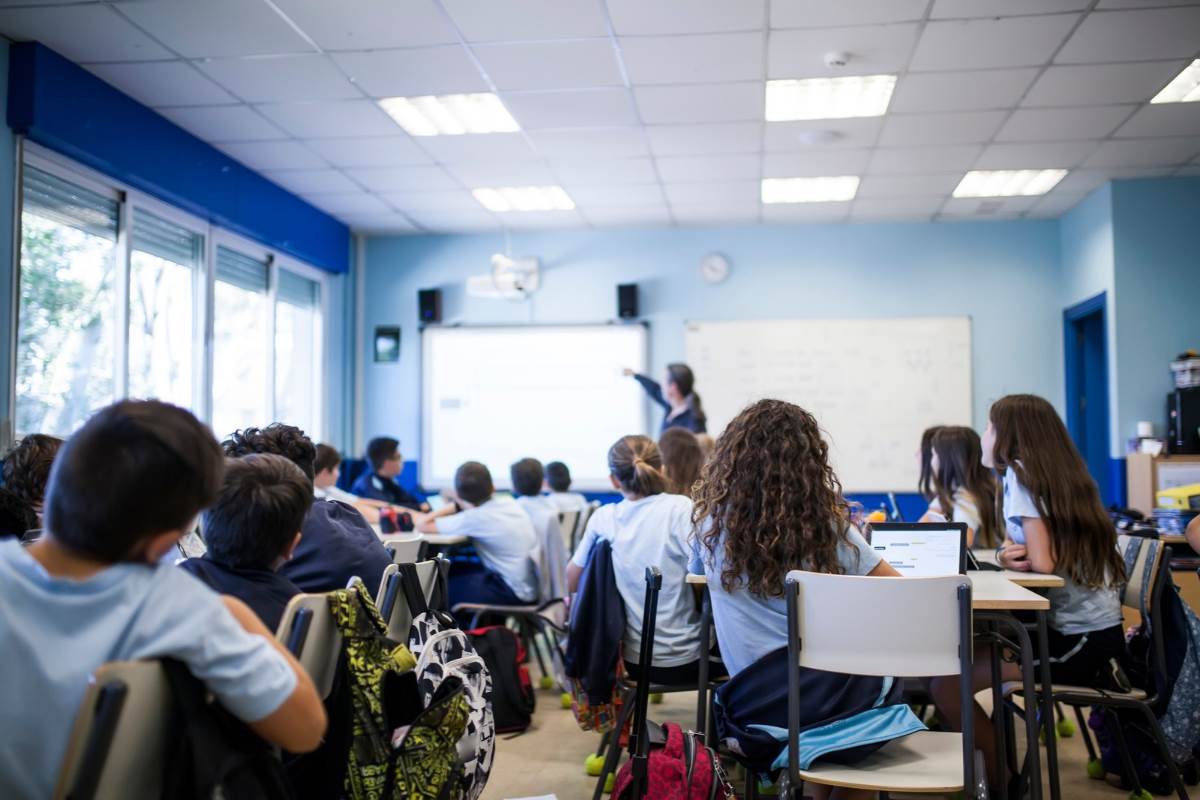
Building Bulletin (BB) 101 is a UK government publication titled “Guidelines on ventilation, thermal comfort and indoor air quality in schools. The current version was published in August 2018 and establishes allowable CO2 levels and BB101 ventilation rates for the principal ventilation methods used in classrooms [1]. However, research published since then raises an important question: does meeting BB101 requirements result in the optimal learning environment for UK students?

Key insights at a glance:
Ventilation design affects much more than compliance. CO2 concentration, outdoor air supply and pollutant filtration all need consideration when assessing the quality of a classroom.
-
BB101 ventilation rates and CO2 criteria depending on whether classroom ventilation is mechanical or natural [1]
-
Monitoring indicates that 20% of naturally ventilated classrooms do not achieve BB101 criteria, particularly during cold weather [2]
-
Research has associated lower classroom CO2 concentrations and higher ventilation rates with improvements in measured learning performance and attendance [6] [7] [8]
-
Natural ventilation in schools cannot provide the same incoming particulate and gaseous pollutant filtration as mechanical systems
-
A 1,000 ppm classroom CO₂ limit, regardless of ventilation method, could establish a consistent basis for future classroom ventilation requirements.
In this article:
- What BB101 Requires for Classroom Ventilation
- Filtration Under BB101
- What Other Regulations Apply?
- What Monitoring Tells Us About Ventilation in Practice
- What Does ‘Well Ventilated’ Mean for a Classroom?
- Evidence from Multiple Classroom Studies: The Link Between CO₂ and Classroom Performance
- What Can we Learn from Ventilation Guidance Elsewhere in Europe?
- Why Ventilation Strategy and Filtration Need to be Considered Together
- Beyond CO₂: Why Filtration Matters: Understanding PM1 and Filtration
- Putting Better Classroom Ventilation into Practice
- Supporting School Ventilation Where Space Is Limited
- References
Prefer to Watch?
In this presentation, David Black explores whether BB101 goes far enough to support healthy, well-ventilated classrooms. From CO₂ levels and learning performance to filtration and comparisons with other European countries, David explains the evidence behind the case for rethinking school ventilation requirements.
Watch the presentation to hear the argument in full, or continue reading below.
What BB101 Requires for Classroom Ventilation
BB101 ventilation rates and CO₂ criteria differ according to the ventilation strategy being used. These differences in classroom ventilation requirements mean BB101 allows naturally ventilated classrooms to operate at higher CO₂ concentrations than mechanically ventilated classrooms.
Where mechanical ventilation is used, or where hybrid systems operate in mechanical mode in general teaching and learning spaces, sufficient outdoor air should be provided to achieve a daily average CO₂ concentration of less than 1,000 ppm during the occupied period, when occupancy is at or below the design level [1].
For general teaching and learning spaces using natural ventilation, or hybrid systems operating in natural mode, BB101 requires:
- Sufficient outdoor air to achieve a daily average CO₂ concentration below 1,500 ppm during the occupied period when occupancy is at or below design occupancy
- A maximum concentration that does not exceed 2,000 ppm for more than 20 consecutive minutes each day
- For new buildings, design for CO₂ levels below 1,200 ppm for the majority of occupied time during the year, based on an assumed outdoor CO₂ concentration of 400 ppm [1].
BB101 therefore allows naturally ventilated classrooms to operate at higher CO₂ concentrations than mechanically ventilated classrooms.
Filtration Under BB101
Section 4.6 of BB101 covers “Filtration and air purification”. It states that filtration may be needed to:
- prevent dirt accumulating in air-handling plant, including on heat exchangers and ductwork; and
- filter out external pollutants [1].
Filtering pollutants that have health effects requires more effective filtration than the simpler filters needed primarily to protect air-handling equipment. BB101 provides further guidance on filtration in section 6.5.2 [1].
What Other Regulations Apply?
BB101 forms part of a wider regulatory and guidance for school ventilation environments.
In England, the School Premises Regulations 2012 and Independent School Standards 2012 apply. These do not cover ventilation or temperature in schools directly but refer to the Workplace Regulations. In Wales, the School Premises Regulations 1999 apply and include requirements on ventilation and temperature.
The Workplace (Health, Safety and Welfare) Regulations 2013 cover a wide range of basic health, safety and welfare issues, including ventilation and temperature. The Approved Code of Practice (ACoP), L24, 2013 gives guidance on application of the Regulations.
This guidance includes several relevant principles:
- Incoming air should, as far as possible, be free of impurities likely to be offensive or cause illness; where necessary, inlet air should be filtered to remove particulates
- Mechanical ventilation systems should be provided where necessary
- Occupants should not be exposed to uncomfortable draughts
- Fresh air supply should not normally fall below 5–8 litres per second per occupant.
This wider context shows that classroom ventilation is not simply a question of meeting a CO₂ threshold. Indoor air quality, thermal comfort and the quality of incoming outdoor air are also important factors.
What Monitoring Tells Us About Ventilation in Practice
Design requirements are one part of the picture. Operational performance is equally important.
The Schools’ Air quality Monitoring for Health and Education (SAMHE) project has published data on indoor air quality in UK schools [2]. By 2024, SAMHE had gathered around 100,000 “school data days” every year from around 450 schools.
For naturally ventilated classrooms, where average CO₂ should remain below 1,500 ppm, SAMHE reported: “When cold outside about 20% of classrooms fail to comply with BB101.” [2]
Evidence from Ireland also illustrates the challenges associated with naturally ventilated classrooms. Although Irish schools do not have to comply with BB101, the 2025 paper “Indoor air quality in naturally ventilated classrooms and offices in Ireland” [3] reported: “Maximum CO₂ concentrations reaching over 4600 ppm”
When compared with BB101's 1,500 ppm daily average for naturally ventilated classrooms, 12 out of 19 classrooms failed to comply. Furthermore, only two of the 19 classrooms did not exceed 2,000 ppm for 20 consecutive minutes [3].
These findings show that naturally ventilated classrooms can struggle to meet BB101's CO₂ criteria in practice, with SAMHE reporting higher rates of non-compliance when it is cold outside.

What Does ‘Well Ventilated’ Mean for a Classroom?
Guidance developed in response to the COVID-19 pandemic provides another useful benchmark.
The Health and Safety Executive (HSE) states: “A consistent CO₂ value below 800ppm is likely to indicate that an indoor space is well ventilated” [4].
It also recommends keeping CO₂ below 800 ppm where there is continuous talking, singing or high levels of physical activity indoors, and states: “CO₂ levels consistently higher than 1500ppm in an occupied room indicate poor ventilation and you should take action” [4].
In classrooms, talking and high levels of physical activity are commonplace, making effective ventilation in schools particularly important. To comply with the HSE recommendations, 800 ppm should therefore be a reasonable target.
UK government guidance published in 2026 for “Ventilation and air quality in education and childcare settings” [5] makes the distinction particularly clear: “If the level is under 800ppm, your ventilation is good.”
Between 800 and 1,500 ppm, ventilation is described as adequate, with consideration given to opening windows or doors to improve it. Above 1,500 ppm, ventilation is described as poor and increased ventilation is advised [5].
This highlights a key challenge for school designers and operators: meeting allowable limits does not necessarily result in an optimal classroom environment.
Why Classroom CO2 Matters for Students
CO₂ concentration is commonly used as an indicator of ventilation effectiveness in occupied spaces.
The key question is therefore not simply whether a classroom complies with BB101 classroom ventilation requirements, but whether ventilation conditions support pupils’ learning and attendance.
A substantial body of research has investigated relationships between classroom CO₂ concentrations, ventilation and learning.
Evidence from Denmark: The Case for Keeping CO₂ Below 900 ppm
The Danish study “Research-based recommendations for achieving high indoor environmental quality in classrooms to promote learning” [6] concluded: “Research has shown how to improve classroom environmental quality in Denmark. Recommendations for main components of indoor environmental quality in classrooms, ensuring optimal performance of schoolwork and learning: Keep CO₂ below 900 ppm at all times.”
Evidence from Multiple Classroom Studies: The Link Between CO₂ and Classroom Performance
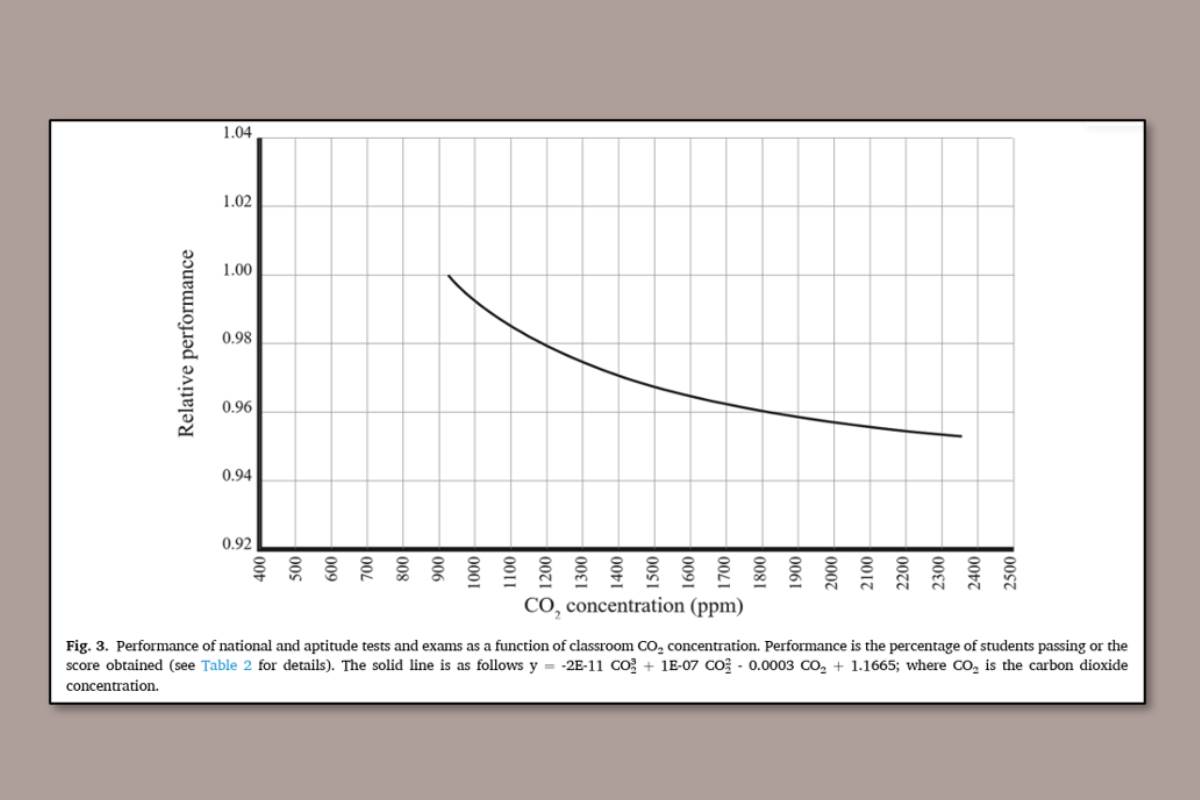
The meta-study “The relationships between classroom air quality and children’s performance in school” [7] examined published research and calculated schoolwork performance at different CO₂ concentrations relative to a reference concentration of 900 ppm. Twenty studies met its inclusion criteria. For four studies assessing the speed and accuracy of set tasks, the authors reported:
“The relationship summarizing the results [of speed, accuracy of set tasks] from four studies is shown in Fig. 3. It indicates that reducing classroom CO₂ from around 2,400 ppm to 900 ppm can be expected to improve children’s performance of national tests by about 5%. The largest change in performance occurred when CO₂ concentration changed from 1,600 ppm to 900 ppm.” [7]
The study also concluded that increasing the ventilation rate from 2.0 l/s per pupil, described as normal for natural ventilation, to 7.5 l/s per pupil, described as typical for mechanical ventilation, increased attendance by 1.5%. [7]

Evidence in Attendance: Higher CO₂, Higher Absence?
An American study, “Associations between classroom CO₂ concentrations and student attendance in Washington and Idaho” [8], concluded that in schools where CO₂ concentration was 1,000 ppm higher than outdoor air, absence was 10–20% higher.
Absence and indoor environmental quality are explored in greater detail in REHVA's “Indoor Environment and Energy Efficiency in Educational Buildings”. [9]
Together, this research supports the case for treating classroom ventilation as an important part of the learning environment, rather than simply as a building-services requirement.
What Can we Learn from Ventilation Guidance Elsewhere in Europe?
Extensive European research has driven individual country regulations. In virtually all cases the allowable CO2 levels in other countries is lower than in the UK.
See how classroom CO₂ targets and limits compare across selected European countries in the table:
| Country | Target / Allowable CO₂ Limit (ppm) | Status and Notes |
| Germany | 1,000 ppm | Follows the Ad-hoc Working Group on Indoor Air Guidelines. Action is recommended if levels exceed this threshold. |
| Finland | 1,000 ppm | Governed by strict residential and public building health decrees. Heavy focus on mechanical ventilation. |
| Norway | 1,000 ppm | National health guidelines recommend keeping levels below this mark for optimal cognitive function. |
| Estonia | 1,000 ppm | Established as the official hygienic standard for schools by the Ministry of Social Affairs. |
| United Kingdom | 1,000–1,500 ppm | Under Building Bulletin 101 (BB101), mechanical systems must keep daily averages under 1,000 ppm. Natural ventilation must average under 1,500 ppm, never exceeding 2,000 ppm for over 20 minutes. |
| France | 1,300 ppm | Governed by the Regular Sanitaire Départemental Type (RSDT). Mean levels should be under 1,000 ppm, but tolerances allow up to 1,300 ppm in rooms without mechanical ventilation. |
| Netherlands | 1,200 ppm | Standard 1089 defines the hygienic threshold for schools at 1,200 ppm, with lower limits for kindergartens (1,000 ppm). |
| Austria | 1,000 ppm | Follows national guidelines for a daily average limit, though recent compliance checks show high exceedance rates in older infrastructure. |
| Lithuania | 1,500 ppm | Hygiene Norm HN34:2007 outlines a teaching-hour average limit of 1,500 ppm, with short-term peaks up to 5,000 ppm tolerated. |
The comparison illustrates why the UK's approach to ventilation for schools, particularly the distinction between natural and mechanical ventilation under BB101, deserves further examination.
Why Ventilation Strategy and Filtration Need to be Considered Together
Selecting ventilation systems for schools involves balancing indoor air quality, thermal comfort, energy performance, operating costs and practical operation.
BB101 itself advocates a holistic, multidisciplinary approach to prevent unintended consequences where designs are driven primarily by low-energy or other overarching objectives. Among the factors influencing design are:
- low-energy performance; and
- lifecycle and operational running costs. [1]
The perceived higher capital and running costs associated with mechanical ventilation for schools have contributed to widespread use of natural and hybrid ventilation in classrooms.
There is also a subtle but important distinction in BB101's wording. For mechanical systems, “sufficient air should be provided to achieve a daily average”, while for natural systems the system is to be designed to achieve the specified CO₂ level “for the majority of the time”. [1]
Ventilation in schools should therefore be assessed against the indoor conditions achieved in occupied classrooms, including CO₂ levels, thermal comfort and exposure to outdoor pollutants.
These requirements also influence the choice of ventilation system, particularly where filtration is required.
The last iteration of BB101 was amended to include the following clause:
“4.15 Climate change adaptation: The future proofing of the indoor environment of teaching spaces is important. The use of the BS EN 15251 adaptive thermal comfort criteria instead of the temperature threshold of 28 °C used in the previous edition of BB101 (2006) provides a more appropriate test for thermal comfort and a more resilient design in the event of climate change.”
This reduces the likelihood of mechanical cooling being installed as it favours natural ventilation systems. As was demonstrated in the summer of 2026 where temperatures exceeded 35°C in June and resulted in many schools being closed.
Mechanical ventilation systems can be adapted to include mechanical cooling and as BB101 suggests:
“Space temperature control set points should be reduced to take full advantage of night cooling during hot weather.”
This is a standard solution in FläktGroup’s eCO FLAT Suspended Air Handling Unit.
Technical Insight: Filtration Changes the Ventilation Equation
Standard natural ventilation in UK schools does not filter incoming air. Instead, outdoor air passes directly through openings such as windows, trickle vents or passive louvres without passing through a filtration medium. That distinction becomes particularly important in locations affected by outdoor air pollution.
Beyond CO₂: Why Filtration Matters: Understanding PM1 and Filtration
Particulate matter measuring less than 1 micron is known as PM1, or PM1.0. Tiny airborne particles like PM1 are small enough to penetrate lung tissue and get into the bloodstream. PM1 can then circulate throughout the body and cause systemic health effects.
BB101:2018 acknowledges the increasing emphasis on smaller particles for health protection and discusses PM2.5. It cites the EU HealthVent study, published in 2013, which advises a minimum PM2.5 reduction of 50%. [1]
Filter classification has subsequently evolved. EN ISO 16890:2016 is now the standard for air filters used in general ventilation. A former F7 filter could correspond to a PM1 arrestance efficiency of 50–60%.
Mechanical ventilation systems incorporate supply filters. Good practice is therefore to specify filtration according to the required supply-air quality and the outdoor-air conditions defined in EN 16798-3:2025.
Beyond Particles: Tackling Gaseous Pollutants
There is a further consideration in polluted urban and industrial environments.
BB101 indicates that F7 filtration – approximately ePM1 50–60% under the newer classification – can meet filtration requirements in polluted areas. However, EN 16798-3:2025 defines a polluted city or industrial area as Outdoor Air Quality category ODA 3.
For a permanently occupied room such as a classroom, Supply Air Quality 2 is recommended. Meeting this requirement needs a total ePM1 filtration efficiency of 80%, together with a gas filter.
Gas filtration addresses pollutants including nitrogen dioxide, sulphur dioxide and ozone, including pollutants associated with vehicle emissions.
Passive natural ventilation cannot overcome the pressure resistance associated with these filtration stages. Natural ventilation systems can never meet these requirements since they don’t have the power to overcome the resistance of the filters.

Putting Better Classroom Ventilation into Practice
Taken together, the evidence highlights the case for classroom ventilation that goes beyond simply meeting minimum CO2 requirements. Ventilation in schools also needs to consider the quality of incoming air and, where outdoor pollution is a concern, the ability to provide effective particulate and gaseous filtration.
For existing schools, however, improving ventilation can present practical challenges. Older buildings and retrofit projects may offer limited space for ductwork and ventilation equipment. This means the solution must deliver the required airflow, filtration, thermal and acoustic performance within the constraints of the building.
This makes space an important consideration when selection ventilation systems for schools. Where traditional conventional air handling equipment is difficult to accommodate, compact mechanical ventilation can prove another route to delivering controlled supply and extract air without losing sight of the classroom conditions the system needs to achieve.
Supporting School Ventilation Where Space Is Limited
Our eCO FLAT Suspended Air Handling Unit provides compact mechanical ventilation for schools and other applications where available installation space is limited.
Its format makes it particularly relevant to projects where accommodating conventional air-handling equipment is difficult, including retrofit applications.
For school projects, selecting ventilation systems for schools is not simply about whether an AHU will fit above a ceiling. The selected configuration still needs to satisfy the project's required airflow, filtration, acoustic, thermal and control criteria.
The ventilation solution should be selected around the classroom requirement, rather than designing the classroom around a product.
That is where compact mechanical ventilation in schools can form part of a broader strategy, providing controlled supply and extract air in situations where space limitations might otherwise restrict the available options.
References
- BB101. https://www.gov.uk/government/publications/building-bulletin-101-ventilation-for-school-buildings — August 2018.
- The SAMHE project hosted webinar on 3 July 2024. https://www.youtube.com/watch?v=EgenIlp6w3g
- “Indoor air quality in naturally ventilated classrooms and offices in Ireland.” Adam K. Collison et al, 16 April 2025 - https://www.sciencedirect.com/science/article/pii/S0360132325005049
- Using CO2 monitors - Ventilation in the workplace
- “Ventilation and air quality in education and childcare settings.” Published 24 February 2026. https://www.gov.uk/government/publications/ventilation-and-air-quality-in-education-and-childcare-settings/ventilation-and-air-quality-in-education-and-childcare-settings
- “Research-based recommendations for achieving high indoor environmental quality in classrooms to promote learning.” Pawel Wargocki and David P. Wyon, International Centre for Indoor Environment and Energy, Department of Civil Engineering, Technical University of Denmark. 13 April 2021. https://cdn.realdania.dk/media/1boezbmk/rapport_engelsk_lang_april.pdf
- “The relationships between classroom air quality and children’s performance in school.” Pawel Wargocki et al, 17 February 2020. https://www.sciencedirect.com/science/article/abs/pii/S0360132320301074
- “Associations between classroom CO2 concentrations and student attendance in Washington and Idaho.” Shendell et al, Lawrence Berkeley National Laboratory, Environmental Energy Technologies Division, Indoor Environment Department, Berkeley, CA, USA. 2004. https://onlinelibrary.wiley.com/doi/10.1111/j.1600-0668.2004.00251.x?msockid=2201fcd0606a681f04e0e8bd611b6924
- “Indoor Environment and Energy Efficiency in Educational Buildings.” REHVA, 2021. https://www.rehva.eu/eshop/detail/indoor-environment-and-energy-efficiency-in-educational-buildings