
When and Why to Use Liquid Cooling for Data Centres
- Theme
- Sustainable performance
- Reading time
- 10 minutes
- Published
- By
- John Woollett
As AI and high-performance computing continue to increase rack densities, data centre operators are re-evaluating how they manage heat. This article explores when liquid cooling becomes necessary, how it can be introduced practically, and why a hybrid approach is often the smartest path forward.
Understanding the New Reality of Data Centre Cooling
The rapid growth of artificial intelligence (AI), machine learning and large-scale data processing is transforming data centre design. For many years, air cooling was sufficient for most data centre applications. Typical rack densities ranged from 8-20 kW per rack, allowing conventional cooling systems to maintain reliable operating conditions while supporting energy efficiency objectives.
However, the rise of hyperscale computing increased densities to around 30 kW per rack, while some AI-focused deployments are now exceeding 100 kW per rack. As computing power increases, so does the amount of heat generated within a smaller physical footprint. This is creating new challenges for operators tasked with maintaining performance, reliability and operational efficiency.
Understanding when liquid cooling becomes necessary and how it can be integrated into existing facilities is becoming an increasingly important part of data centre planning.
Key Insights at a Glance
The growth of AI and high-performance computing is driving rack densities beyond the practical limits of traditional air cooling in some applications. While liquid cooling is becoming increasingly important, many operators can achieve successful outcomes through a phased hybrid strategy.
- AI workloads are driving rack densities beyond 100 kW in some deployments
- Liquid cooling removes heat significantly more effectively than air
- Hybrid cooling enables a gradual transition without replacing existing infrastructure
- Direct-to-chip and rear-door heat exchangers are often practical starting points
- Cooling infrastructure should be designed to support future scalability as computing demands evolve.
In this article:
- Why Data Centre Cooling is Changing
- Why Higher Heat Loads Matter
- Understanding Why Liquid Cooling Works
- Sustainability and Liquid Cooling Selection
- The Hybrid Cooling Approach
- Technical Insight: Creating a Liquid-Cooled Zone
- More Computing Capacity Within Existing Space
- Opportunities for Higher Cooling Water Temperatures
- Building for Future Growth
- FläktGroup Expertise in Data Centre Cooling
- Meeting AI Demands with Advanced Liquid Cooling Solutions
- The Future of Data Centre Cooling Is Hybrid
Why Data Centre Cooling Is Changing
In recent years, demand for efficient cooling in data centres has surged alongside the growth of AI, cloud computing and large-scale data processing. Historically, chip manufacturers responded to increasing computing demands through architectural changes such as the move from single core to multi-core processors. This allowed computing performance to increase without dramatically increasing thermal loads.
Today, the situation is different.
Modern AI accelerators and GPUs consume significantly more power than previous generations of hardware. As a result, heat loads are increasing faster than traditional air-cooling systems were originally designed to manage.
Why Higher Heat Loads Matter
Cooling infrastructure plays a critical role in maintaining data centre performance and reliability. If heat cannot be removed effectively:
- Server performance can be reduced through thermal throttling
- Component lifespan may be affected by thermal stress
- Operational resilience can be compromised
- Energy consumption may increase as cooling systems work harder to maintain conditions.
At the same time, operators face increasing pressure to improve building performance and operational efficiency.
European regulations, including the Energy Performance of Buildings Directive (EPBD) and Building Automation and Control Systems (BACS) requirements, continue to encourage smarter, more efficient building operation and monitoring.
Cooling is therefore no longer simply an operational necessity. It has become a strategic consideration that influences capacity planning, infrastructure investment and future growth.
Understanding Why Liquid Cooling Works
The adoption of liquid cooling has accelerated because liquids transfer heat significantly more effectively than air. Water has a higher density, greater specific heat capacity and lower thermal resistance than air. This means a relatively small volume of liquid can transport a substantial amount of heat. In fact, water's volumetric heat capacity is approximately 3,400 times greater than that of air.
As rack densities increase, delivering enough airflow to remove heat becomes increasingly challenging. Higher airflow rates require larger fans, greater energy input and increasingly sophisticated control systems.
Liquid cooling provides an alternative approach by removing heat closer to its source. This makes it particularly attractive for:
- Artificial intelligence workloads
- High-performance computing (HPC)
- GPU-intensive applications
- High-density server environments
Sustainability and Liquid Cooling Selection
In addition to thermal performance, cooling fluid selection is becoming an increasingly important consideration for data centre operators. Different liquid cooling technologies utilise different fluid types, each with its own operational and environmental characteristics.
| Cooling Method | Typical Fluid | PFAS Risk |
| Direct-to-chip (PG25, water/glycol) | Water/glycol | Very low |
| Single-phase immersion | Hydrocarbon/synthetic dielectric oil | Usually PFAS-free |
| Two-phase immersion | Fluorinated dielectric fluid | Historically PFAS-containing |
Direct-to-chip cooling systems commonly use water/glycol mixtures such as PG25. These formulations are typically PFAS-free and hydrocarbon-free, which may be a consideration for organisations assessing future cooling strategies and cooling fluid selection.
The Hybrid Cooling Approach
Hybrid cooling combines traditional air cooling with targeted liquid cooling. By mapping existing workloads and future requirements, operators can identify where air cooling remains appropriate and where liquid cooling should be introduced. A hybrid strategy typically allows organisations to:
- Retain existing cooling assets
- Minimise operational disruption
- Introduce liquid cooling incrementally
- Support AI and HPC deployments
- Align investment with business requirements
For example, an organisation may continue using air cooling for legacy servers and networking equipment while creating dedicated liquid-cooled zones for AI clusters and GPU-intensive workloads.
This approach maintains operational continuity while creating a pathway towards higher rack densities.
Technical Insight: Creating a Liquid-Cooled Zone
Once liquid cooling has been identified as a requirement, the next step is selecting the most appropriate technology. Several options are available.
Rear-Door Heat Exchangers
A rear-door heat exchanger is mounted to the back of a server rack and uses water to remove heat from exhaust air before it enters the room. This approach enables higher rack densities while maintaining familiar server architectures and operating procedures. Benefits include:
- Relatively straightforward integration
- Familiar maintenance practices
- Increased cooling capacity
- Minimal changes to IT hardware.
Direct-to-Chip Cooling (D2C)
Direct-to-chip cooling delivers coolant directly to cold plates mounted on processors and GPUs. Heat is removed at its source, making this approach particularly effective for AI and HPC applications. Benefits include:
- Efficient processor cooling
- Support for high-density deployments
- Reduced dependence on high-volume airflow
- Strong suitability for AI workloads.
Immersion Cooling
Immersion cooling submerges servers within dielectric fluid. While highly effective from a thermal perspective, it often requires substantial changes to facility design, maintenance procedures and operational practices. Some operators may also encounter hardware compatibility and warranty considerations. For these reasons, immersion cooling is less commonly selected as an initial transition strategy.
More Computing Capacity Within Existing Space
Because liquid cooling removes heat more effectively than air, it can support higher rack densities within the same footprint. This may allow organisations to increase computing capacity without expanding facility space, subject to site-specific infrastructure constraints.
Opportunities for Higher Cooling Water Temperatures
Liquid cooling systems can often operate at higher cooling-water temperatures than traditional chilled-water systems. Depending on climate and system design, this can create opportunities to increase the use of free cooling and reduce reliance on mechanical cooling equipment.
Building for Future Growth
Perhaps the greatest advantage of a hybrid strategy is flexibility. Most organisations cannot accurately predict how quickly AI adoption and data growth will affect future rack densities. A phased approach allows cooling infrastructure such as:
- Cooling Distribution Units (CDUs)
- Pipework networks
- Heat rejection systems
- Monitoring platforms
to be deployed incrementally as demand grows.
This allows organisations to evolve alongside changing customer and technology requirements without undertaking disruptive facility-wide upgrades.

FläktGroup Expertise in Data Centre Cooling
At FläktGroup, we work with consultants, contractors and data centre operators to develop cooling strategies that support both current and future requirements. Our expertise spans:
- Precision air cooling
- Hybrid cooling strategies
- Liquid cooling infrastructure
- Data centre controls and optimisation
- High-density AI applications
We believe successful liquid cooling adoption begins with understanding the workload, thermal requirements and long-term operational objectives of each facility.
For many operators, the most effective solution is not choosing between air and liquid cooling but understanding how both technologies can work together.
Our team of experts are ready to help you on your Data Centre journey:
Meeting AI Demands with Advanced Liquid Cooling Solutions
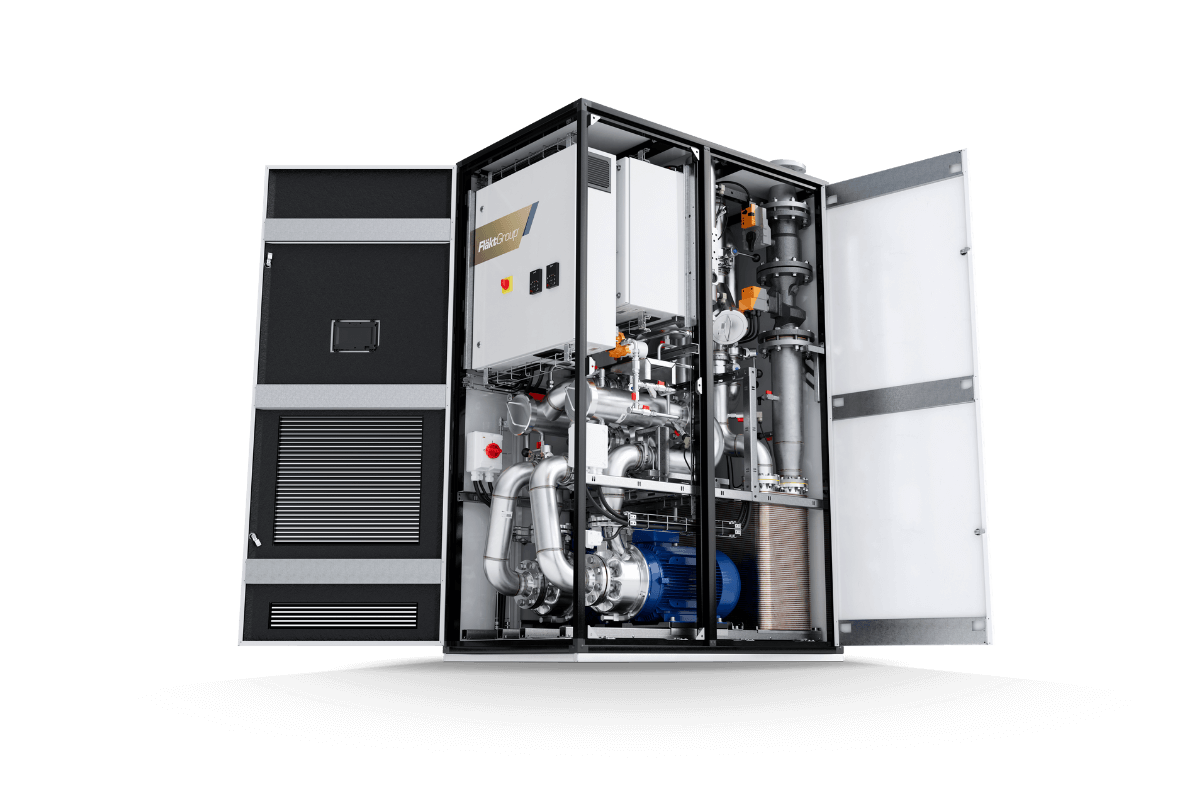
To meet growing demand for liquid cooling, FläktGroup has developed, FläktGroup has developed Liquid DENCO, a coolant distribution unit (CDU) designed for high-density data centre environments. Liquid-DENCO provides precise thermal management between facility cooling infrastructure and liquid-cooled IT equipment.
Key Features
- Designed to support evolving data centre requirements
- Precise coolant flow and temperature control
- Flexible integration with liquid-cooled environments
- Scalable deployment options
- Suitable for high-density AI and HPC applications
Liquid-DENCO forms part of a wider cooling strategy, helping operators manage increasing thermal loads while preparing for future growth.
In this video, Ömer Tüzer, Chief Technology Officer at FläktGroup, explores the benefits of liquid cooling and the capabilities of Liquid-DENCO for modern data centre infrastructure.
The Future of Data Centre Cooling Is Hybrid
The transition to liquid cooling does not need to be an all-or-nothing decision.
As rack densities continue to increase, particularly in AI and HPC environments, many organisations will need to introduce liquid cooling in some form. However, that does not mean existing air-cooled infrastructure must immediately be replaced.
A hybrid cooling strategy offers a practical and scalable path forward, combining the reliability and familiarity of air cooling with the performance advantages of liquid cooling where higher thermal loads demand it.
By understanding workloads, assessing future growth requirements and selecting the right technologies, operators can create cooling strategies that support both current operations and future innovation.
Want to know more? Contact a CDU specialist by utilising our form below: