
- FläktGroup
- FläktGroup Insights: Driving Innovation
- BREEAM refrigerant impact: why integrated R32 ReCooler systems achieve lower GWP than conventional external condensers
BREEAM refrigerant impact: why integrated R32 ReCooler systems achieve lower GWP than conventional external condensers
- Theme
- Sustainable performance
- Reading time
- 12:00
- Published
- By
- Tom Findley
Low-carbon building design is becoming increasingly more important as building regulations pay close attention to refrigerant GWP, energy performance and overall CO2 emissions. We look at how BREEAM evaluates GWP and why integrated solutions like our R32 ReCooler achieve lower assessed emissions.
Understanding refrigeration choices for BREEAM performance
Having a building meet the standards of BREEAMs methodology is a sure-fire way to ensure your building is meeting the highest of building regulations. When cooling and heating are delivered into a building via an Air Handling Unit (AHU), it is important to choose the right system. There is a huge market out there and it doesn’t help that regulations have become increasingly complex in their demands on buildings. But by aligning with the methodology of BREEAM, we create systems ready to meet any stringent requirements.

Choosing the right AHU for your building is not always simple or clear. But there are often two approaches that designers typically choose between:
- Conventional split DX system – This is where a cooling or heat-pump coil inside the AHU is connected to an externally mounted condenser, with all the pipework installed and charged on site.
- Integrated DX solution (ReCooler) – The entire heat pump circuit is built inside the AHU, delivered to site pre-piped, pre-charged and factory tested.
Now, I may be biased but out of these two options there seems to be a clear winner. But let’s not take my word for it, let’s take the word of our friend BREEAM.
Both approaches deliver heating and cooling, but BREEAM evaluates them very differently, particularly in terms of refrigerant leakage and environmental impact. We want to explain how BREEAM assesses this refrigerant impact and how our ReCooler achieves lower Global Warming Potential (GWP) emissions. By explaining this we hope to show you why an integrated design delivers both better BREEAM performance and lower running costs.
But before we get into this, perhaps you may not be all too familiar with BREEAM and that’s okay because we’ve got you covered. Check out our article here that explains all about BREEAM and what it means for you:
Key Takeaways
Integrated R32 ReCooler systems achieve far stronger BREEAM refrigerant performance than traditional split DX arrangements because their sealed, factory‑built design dramatically reduces leakage, improves system efficiency and secures key BREEAM credits with ease.
- Integrated ReCoolers produce much lower BREEAM‑assessed GWP thanks to minimal refrigerant leakage.
- Factory‑sealed design earns both DELC and leak‑detection BREEAM credits without extra site components.
- Split DX systems face high emissions penalties due to their 15% annual leakage rate.
- Since both use R32, the advantage comes from system design, not refrigerant choice.
- Optimised coil placement boosts energy efficiency, reducing electricity use and lifetime CO₂ impact.
How does BREEAM assess refrigerant impact?
Following the methodology of BREEAM, in the New Construction v7, Pol 01 – Impact of Refrigerants, the criteria now mandates that all refrigerant gases have zero ozone depletion potential. This is highlighting the increasing importance of reducing greenhouse gas emissions from building operations.
How to get BREEAM credits
By following these mandates, you can be rewarded with BREEAM credits and this section awards credits based on two important factors:
1. Direct effect life cycle (DELC) CO2-eq emissions
This measures the environmental impact refrigerant leakage over the lifetime of a system. DELC depends on:
- Refrigerant GWP
- Total refrigerant charge
- Annual leakage rate
- Equipment lifespan
So, a system with DELC < 1000kg CO2-eq/kW would earn a BREEAM credit.
Sounds complicated but let's break it down. BREEAM’s DELC threshold – the 1000kg CO2-eq/kW limit – works like a sustainability checkpoint. So, if your AHU’s “refrigerant tank” drips less than a certain amount over its lifetime, the system will earn a BREEAM credit.
Let’s go back to our two approaches to AHUs:
- The conventional split DX system, which has higher leakage, has a DELC three times that of our ReCooler. It is safe to assume a similar refrigerant charge since cooling power is a function of refrigerant load.
- Integrated DX solution, that’s our ReCooler, has minimal leakage and easily stays under the limit and earns you the BREEAM credit.
Because ReCooler is factory-sealed and uses much less pipework, its “tank” drips far less – meaning it meets BREEAM’s DELC requirements. That’s one point for us.
To illustrate how the ReCooler performs under BREEAM’s DELC methodology, we’ve recreated the relevant section of the official BREEAM refrigerant calculator using the data available for our ReCooler size 11 (12 kW, 2.5 kg R32 charge, 5% leakage rate).
ReCooler R32 DELC calculation using BREEAM Pol 01 assessment method
| System type/name | R-number | System capacity (kW) | Total refrigerant charge (kg) | Operational life (yr) | Refrigerant global warming potential | Annual leakage rate (% refrigerant charge) | Annual purge release factor (%refrigerant charge) | Probabiliy factor for catastrophic failure (%) | Refrigerant recovery efficiency (%) | Refrigerant loss (operational) | Refrigerant loss (retirement) | Total refrigerant loss (kg) | CO2 equivalent (kg) | Direct emissions life cycle kgCO2 equiv/kW coolth capacity | |
| ReCooler size 11 | R32 | 12.00 | 2.50 | 15 | 675 | 5.00% | 0.00% | 1.00% | 95.00% | 2.25 | 0.13 | 2.38 | 1603.13 | 133.59 |
2. Leak detection
As R32 is a A2L refrigerant the system must have leak detection to comply with EN-378 and IEC 60335-2-40:2018 (edition 6.0). BREEAM also recognises that even with good system design, every refrigerant circuit has the potential to leak over time. That’s why in addition to assessing the overall leakage impact (DELC), BREEAM awards a separate credit for systems that include leak detection technology. This operates as an early warning system for an AHU’s refrigerant circuit.
Why BREEAM rewards systems with leak detection:
- It ensures any loss of refrigerant is found quickly, before it becomes an environmental issue
- It reduces the amount of refrigerant lost, which lowers the systems lifetime carbon impact
- It protects system performance, because even a small drop in charge can reduce overall efficiency
- It reduces running costs, as refrigerant top-ups and unplanned downtime can be costly.
For integrated solutions like our ReCooler, leak detection is built in as standard making it automatically qualify for this extra BREEAM credit. All done without any additional components, wiring or complexity on site – it is as simple as that.
Annual Leakage Factors in BREEAM Assessment
One of the key factors in BREEAM’s refrigeration assessment is the annual leakage rate, which is the percentage of refrigerant a system is expected to lose each year over its lifetime. BREEAM provides default leakage rates for different system types to ensure assessments are fair, consistent and independent of manufacturer claims.
The table below (taken from Pol 01 – Impact of Refrigerants) illustrates how these leakage rates vary by the system type:
| System Type | Annual Leakage Rate (% of charge per annum) |
| Air-conditioning Systems | |
| Unitary split | 15% |
| Small-scale chillers | 10% |
| Medium or large chillers | 5% |
| Heat pumps | 6% |
In your traditional AHU with an external condenser arrangement, this system would be classified as a split DX system, which carries the highest leakage rate of 15%. This is because:
- Refrigerant circuit is split across two separate pieces of equipment
- Connections are made on site not in a controlled manufacturing environment
- Split systems require long pipe runs, which means more potential leak points
- External condenser is at risk to weather, corrosion and physical wear
- More maintenance checks required and every time this introduces a potential leak risk.
By contrast, our ReCooler, which falls under the medium chiller category, is assessed at just 5% leakage. This is because it is:
- Factory-sealed with all the pipework contained inside the AHU
- Pressure tested, charged and commissioned before leaving the factory
- Delivered as a complete, self-contained refrigerant circuit, with no site-installed joints
- Protected inside the AHU casing with no exposure to weather
- Free from any external long pipe runs.
Ding ding, that’s another point to our ReCooler.
Refrigerant type R32
Most external condensers now use R32 as the standard refrigerant and our R32 ReCooler uses the very same refrigerant. This means the comparison between a traditional split DX system and the ReCooler is genuinely like-for-like. There is no advantage gained from switching to a lower GWP refrigerant and no penalty applied for using an outdated one. The only real difference in environmental impact comes from how the refrigerant circuit is designed, not necessarily from the refrigerant itself.
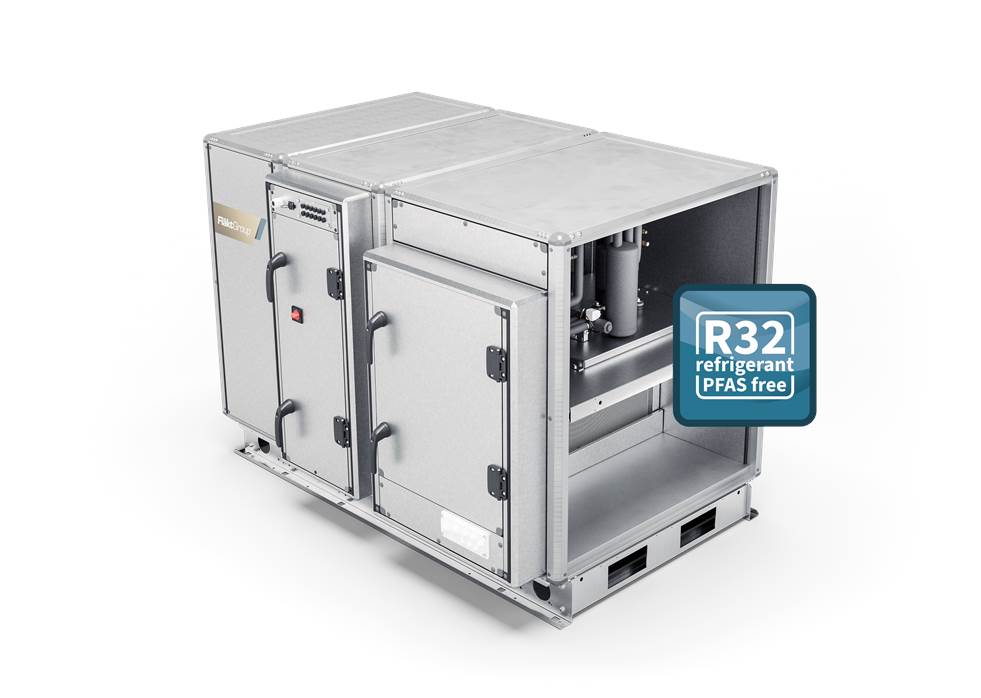
But that’s not to say the refrigerant type doesn’t matter at all. R32 is widely adopted because it strikes a strong balance between environmental performance and technical capability. It has a lower GWP than legacy refrigerants while still offering excellent efficiency, thermodynamic performance and broad market support and is PFAS free!
If you’re interested in understanding our wider refrigerant roadmap and getting to grips with R32, then you can read our article that dives deep into this here:
Integrated DX design – Why coil positioning matters around the heat recovery motor
We’ve mentioned our integrated DX design a lot and you may be wondering what exactly that means. It means that the complete heat pump circuit - including the compressor, evaporator coil, condenser coil, expansion device and all refrigerant pipework – is fully housed inside the AHU as one factory-built sealed system. Pretty cool right.
In practical terms this means:
- All refrigerant components are inside the AHU
- The system is fully factory-assembled and pre charged
- Heat pump works directly with the AHU’s heat recovery system
- Installation is much simpler
- BREEAM benefits with lower leakage rate.
The ReCooler method
Let’s look at exactly how this design translates to our ReCooler design.
Unlike traditional systems, the ReCooler places the exhaust coil on the outdoor air (atmospheric) side of the rotor. This allows the rotor to work as intended:
- In winter, it recovers useful heat from the extract air
- In summer, it recovers useful cooling energy
- The heat pump no longer competes with the energy recovery process.
This ReCooler delivery:
- Lower compressor power consumption
- Lower running costs
- Lower indirect CO2 emissions from electricity use
- Less strain on the system, reducing lifetime leakage risk
This design pairs efficiently with BREEAM refrigerant guidelines, resulting in a system that is both environmentally and operationally superior.
ReCOOLER® PREMIUM HP (HEAT PUMP)
A cutting-edge integrated heating and cooling solution designed to optimise energy efficiency and climate control in commercial and industrial applications.
This unit delivers exceptional heating and cooling performance, ensuring reliability, flexibility and precise temperature regulation. Minimising energy consumption and environmental impact a complete sustainable solution.
Our ReCooler HP systems can be seamlessly integrated with our various air handling units, providing a versatile and adaptable approach to climate management. The modular design allows for scalability, ensuring your system adapts to changing environments.
Features of the ReCooler HP range include:
- Highly efficient heat recovery
- Compact and flexible design
- Intelligent controls